





Magdeburg University Medical Center brings together comprehensive expertise at the Center for Brain Health
Prevention, diagnosis, therapy, and research from a single source—the new center provides guidance and supports those affected with concentrated expertise
Magdeburg University Hospital is founding the “Center for Brain Health”, thereby pooling its outstanding clinical and scientific expertise in an area of particular social relevance. The aim is to provide comprehensive support for people with neurological, neurodegenerative, and mental illnesses – from prevention and diagnosis to treatment and long-term aftercare.
The official launch event will take place on May 6, 2026, in Lecture Hall 7 on the campus in Magdeburg. Representatives from politics, science, healthcare, and society are invited to learn about the center's goals, structures, and perspectives.
Response to key social challenges
The center brings together structures that have grown over decades and consolidates them under one roof. This creates a central point of contact that strengthens the coordinated care of people with brain and mental disorders and offers guidance in a complex field.
The center is responding to demographic change and the sharp increase in neurodegenerative and mental illnesses. Early detection, targeted therapies, and new treatment approaches—such as antibody therapies—open up new opportunities to influence the course of disease and maintain quality of life.
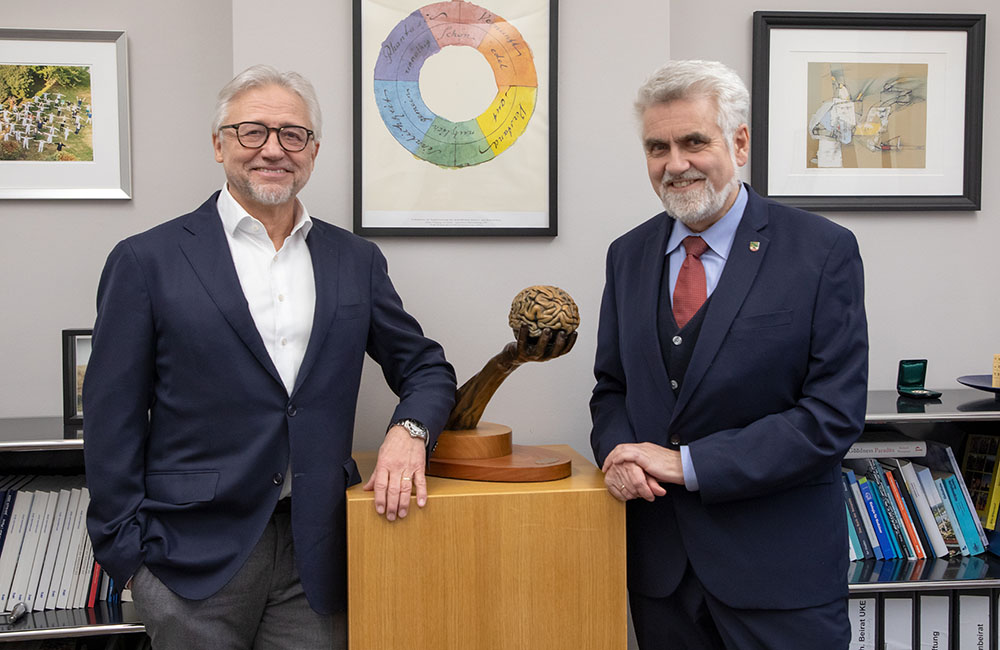
photo: (from left) Prof. Hans-Jochen Heinze, MD, Medical Director of Magdeburg University Hospital, and Prof. Armin Willingmann, Minister of Science and Chairman of the Supervisory Board of Magdeburg University Hospital, are excited about the new Center for Brain Health. Photographer: Melitta Schubert / UMMD
Holistic care for patients and their families
The spectrum ranges from neurodegenerative diseases such as Alzheimer's or Parkinson's to strokes and mental illnesses to innovative imaging and neuroradiological procedures, which are treated on an interdisciplinary basis and supplemented by individual aftercare.
Strong partners – nationally and internationally networked
Magdeburg is one of Europe's leading centers for neuroscience. In more than 30 years, an internationally visible research and care landscape has emerged – with the largest memory clinic in Saxony-Anhalt and links to European dementia and brain health networks.
A central role is played by the Collaborative Research Center 1436 “Neural Resources of Cognition”, which investigates how the brain remains capable despite aging processes and how cognitive abilities can be maintained or strengthened.
The center cooperates closely with the Center for Behavioral Brain Sciences (CBBS) at Otto von Guericke University Magdeburg and, nationally, with the German Center for Neurodegenerative Diseases (DZNE), the Leibniz Institute for Neurobiology (LIN), and the German Center for Mental Health (DZPG). International partners include the University of Iowa and the Allen Institute for Brain Science. This network accelerates the transfer of research results into new therapies.
High-tech for world-class research
The scientific strength of the location is also based on state-of-the-art key technologies: a high-resolution 7-Tesla MRI system and a world-leading 7-Tesla connectome make the finest structures of the brain visible, a PET-MRI allows the visualization of molecular processes in the brain, and state-of-the-art microscopy provides insights into the nanostructure of nerve cells. In addition, state-of-the-art molecular techniques such as spatial transcriptomics are available on site, enabling precise analysis of gene activity – these are crucial for collaboration with the pharmaceutical industry.
The close integration of basic research, translation, and clinical practice ensures rapid benefits in patient care. The site is also a leader in Germany in the research of so-called “super agers,” people who remain exceptionally capable even in old age. New prevention and intervention approaches are being tested in collaboration with general practitioners via the Middle Elbe Research Platform. Spin-offs are also accelerating the transfer into practice.
"With the Center for Brain Health, we are creating a structure that systematically brings together clinical excellence and cutting-edge international research. Our goal is to offer patients of all ages the highest level of care – from prevention to innovative therapy. Magdeburg is thus a beacon of visibility both nationally and internationally," emphasizes Prof. Hans-Jochen Heinze, Medical Director of Magdeburg University Hospital.
Prof. Daniela Dieterich, Dean of the Faculty of Medicine, highlights the close connection between care and research: "At our Magdeburg location, we are broadly positioned along the entire scientific value chain – from basic research and clinical studies to new therapies, spin-offs, and industrial collaborations. This interaction enables us to quickly translate research findings into concrete improvements for patients."
New collaborations—such as with the emerging Heart Center—are also intended to integrate the close connection between heart and brain health more strongly into clinical practice in the future.
Strengthening the science and health location
The state government also recognizes the strategic importance of the new center.
“The establishment of the Center for Brain Health underscores the outstanding role of university medicine in the field of neuroscience. Innovations are being developed here that have an impact far beyond Saxony-Anhalt. The state will continue to support this beacon because it combines scientific excellence with concrete benefits for people,” explains Science Minister Prof. Dr. Armin Willingmann.
Health Minister Petra Grimm-Benne says: “Due to the high average age of the population, our state is heavily affected by neurodegenerative diseases such as dementia and Parkinson's. The new Center for Brain Health strengthens Saxony-Anhalt as a health location. The combination of prevention, diagnostics, and therapy will benefit the state's aging population in particular.”
Since the 1990s, neuroscience has been consistently expanded and strategically promoted in Magdeburg. The establishment of the center now marks another milestone and strengthens the leading role of Saxony-Anhalt as a location for neuroscience, as well as its growing national and international significance.
Kick-off event on May 6, 2026
The event “Center for Brain Health” on May 6, 2026 offers insights into current research projects, innovative therapeutic methods, training initiatives, and industrial collaborations. In addition to scientific presentations, the focus will be on the strategic development of the center and future approaches to care and research.
With the center, Magdeburg University Hospital is sending a clear signal: for modern, interdisciplinary, and internationally networked medicine that focuses on prevention, resilience, and quality of life—and thus opens up new perspectives for healthy living in an aging society.