






Medical data for better care: Magdeburg strong in the University Medicine Network
How networked research from Magdeburg is improving treatment processes throughout Germany and benefiting patients in practice
How can medical data help to provide patients with faster and more targeted care, improve treatment processes, and make the healthcare system more resilient? Answers to these questions were provided at the event “NUM@UMMD – Research Initiatives and Opportunities of the University Medicine Network at Magdeburg University Hospital,” which took place on January 29, 2026, on the campus of Magdeburg University Hospital. Around 100 participants from clinics, research, and politics took the opportunity to present current projects and exchange ideas about the potential of networked medical research in the presence of Saxony-Anhalt's State Secretary for Science, Thomas Wünsch.
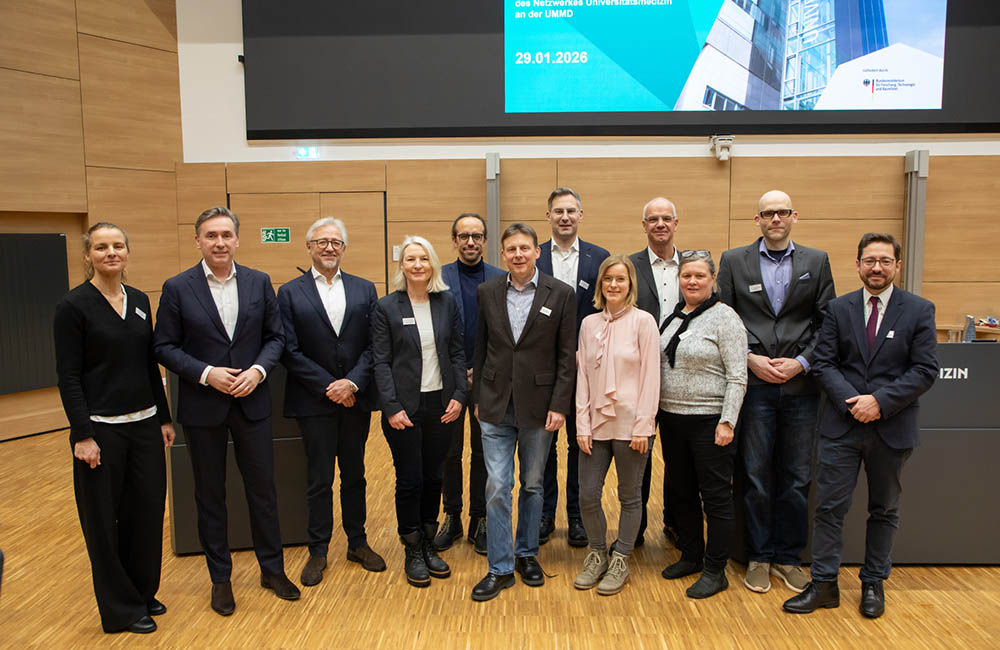
Unimedizin in Magdeburg is represented by many participants in numerous NUM projects. These and other guests from clinics, research, and politics discussed the potential of networked medical data at the “NUM@UMMD” event at the University Medical Center Magdeburg, including State Secretary for Science Thomas Wünsch (2nd from left), Prof. Achim Kaasch, MD (6th from left), NUM site manager in Magdeburg, Ralf Heyder (6th from right) from the NUM coordination office at Charité Universitätsmedizin Berlin, and Prof. Hans-Jochen Heinze, Medical Director of Magdeburg University Hospital A.ö.R. Photographer: Melitta Schubert/UMMD
Magdeburg University Hospital has been part of the University Medicine Network (NUM) from the very beginning. Since 2020, this network has connected all 37 university medical centers in Germany. The aim of NUM is to collect and use medical data nationwide in order to enable practical research and offer patients better care.
In Magdeburg, important infrastructure has been built up for this purpose in recent years, including a data integration center that processes clinical data for research projects, the specialist network for infections, and the AKTIN emergency room register, which makes data from emergency care available on a daily basis. Between 2021 and 2025, a total of €10.6 million will be invested in the NUM location in Magdeburg, with a further €9.1 million planned by 2030.
Prof. Dr. Achim Kaasch, site manager in Magdeburg and director of the Institute for Medical Microbiology and Hospital Hygiene at Otto von Guericke University Magdeburg, explains: “With its infrastructure and specific projects such as RAPID and SNAP, Magdeburg is demonstrating how data from clinical practice can be made available for research – securely, responsibly, and directly for the benefit of patients.”
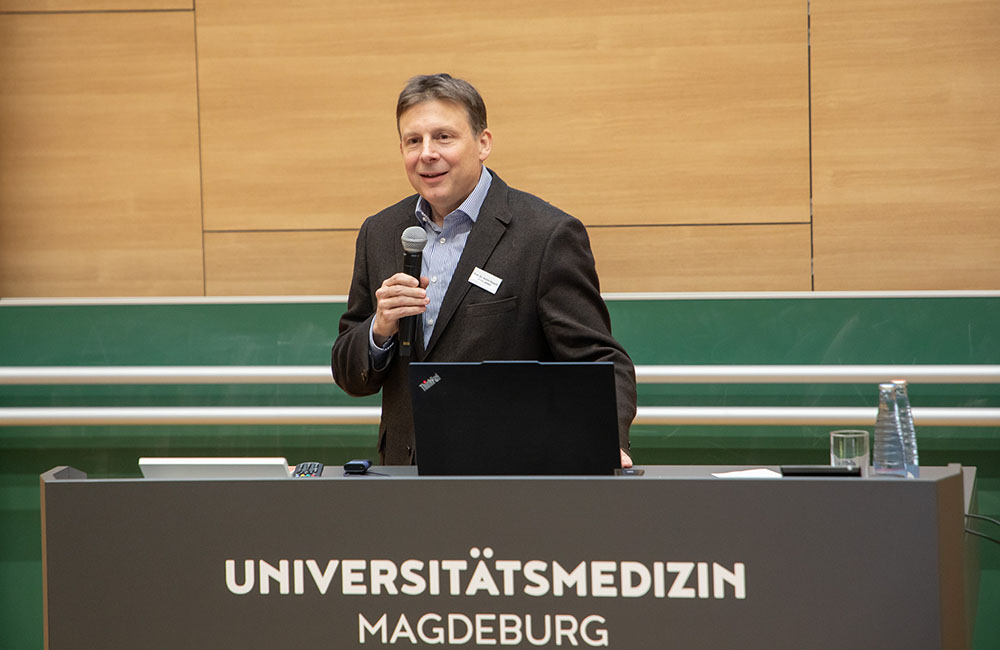
Photo: Prof. Dr. med. Achim Kaasch, NUM Site Manager Magdeburg. Photographer: Melitta Schubert/UMMD
Practical projects at a glance
- AKTIN – the digital emergency platform: The platform collects data from emergency rooms on a daily basis, e.g., on injuries, heart attacks, or strokes. This data is evaluated anonymously in order to improve processes. For example, emergency teams will be able to decide more quickly which patients need immediate treatment.
- The NUM study network with the specialist network for infections: Here, data from cases of infection is used to better understand the diseases and detect outbreaks at an early stage. The network also conducts large-scale therapy studies on antibiotics (SNAP).
- RAPID – Register for routine clinical data from pediatric and adult intensive care patients: RAPID analyzes data from intensive care units, such as ventilation, circulation, or medication, to check the quality of treatment. The results help to improve treatment and therapy decisions in an evidence-based manner and to tailor treatment to the individual needs of patients.
- RACOON – Radiology Cooperation: Radiological image data is collected in a shared network and evaluated in a structured manner using AI tools. This facilitates diagnoses, speeds up reporting, and enables research projects that develop new image markers for diseases, for example.
The event also featured poster presentations introducing NUM projects and the researchers involved in Magdeburg. This promoted professional exchange and showed how closely research, clinics, and young scientists work together.
State Secretary for Science Thomas Wünsch emphasized in his welcoming address: "Cooperation instead of competition. This goal of the German University Medicine Network is also part of the agenda in Saxony-Anhalt.
Our university hospitals in Halle and Magdeburg are working ever more closely together and are also firmly integrated into the nationwide network. On the one hand, this strengthens research and teaching and, on the other hand, ensures the transfer of the latest scientific findings and therapy options into everyday clinical practice." Prof. Dr. med. Hans-Jochen Heinze, Medical Director at Magdeburg University Hospital A.ö.R, emphasized in his welcoming speech:
“As a strong location in the University Medicine Network, Magdeburg has been actively involved in the development of important research structures from the very beginning. Projects on emergency, intensive care, infection, and imaging data flow directly into patient care, thereby improving the treatment of patients. At the same time, the close cooperation between research and clinical practice creates optimal conditions for young scientists.”
At the end of the event, an outlook on NUM 3.0 was presented: Consolidating the structures that have been established, integrating new clinical pictures, and further data-based research projects are intended to improve care in the long term.
About the University Medicine Network (NUM)
For the first time, all 37 German university medical centers are conducting large interdisciplinary clinical research projects together in the NUM. Launched to coordinate COVID-19 research in German university medicine, the focus today is on the joint collection and use of complex medical research data in a clinical context. To this end, the network has established specialized research infrastructures: https://www.netzwerk-universitaetsmedizin.de/.
Dynamic content of the page: Content gallery NUM, client ummd